Published on August 5, 2026
Choosing the Right FLT for Your Business
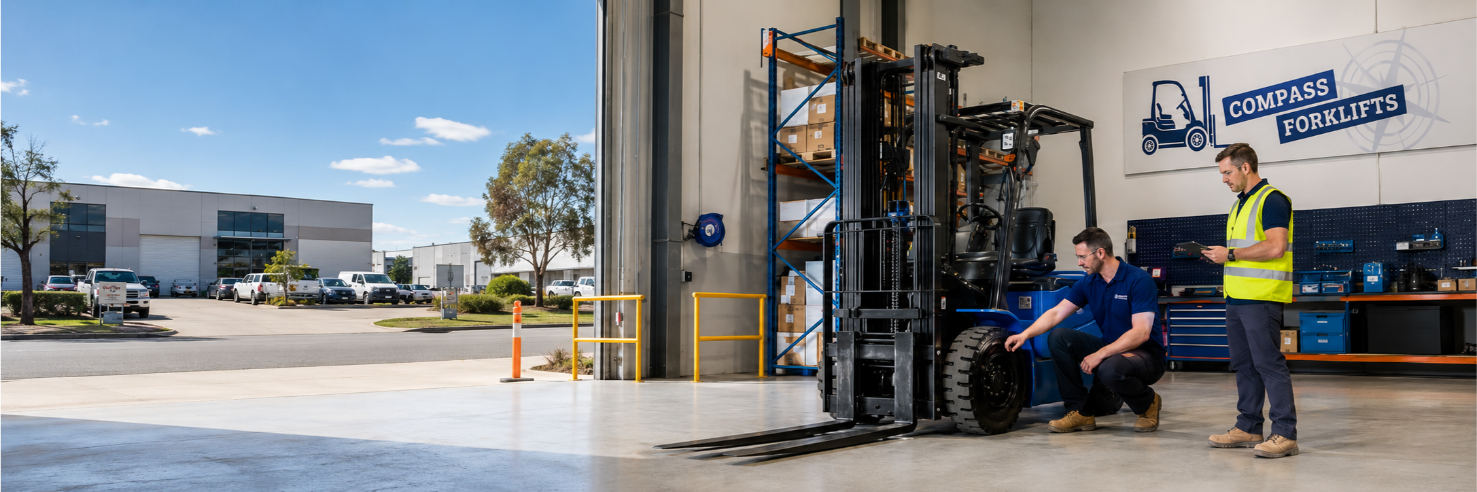
A helpful guide for Perth warehouses, yards and logistics sites
Some buyers know exactly what they need. They arrive with the required capacity, mast height, fuel type and attachment list already worked out.
Others simply know the current setup is no longer working. Pallets are backing up, loading takes too long or the existing forklift is spending more time being repaired than moving stock.
Both are normal starting points.
The important part is making sure the forklift you choose works in the real conditions of your site. The rated capacity matters, but so do the turning circle, collapsed mast height, ramp gradient, tyre type, power source and number of hours the truck will work each day.
A forklift can have the right number written on the side and still be completely wrong for the job.
This guide explains the checks worth making before you buy, hire or lease an FLT for your Perth business.
What should you check before choosing a forklift?
A useful forklift specification should answer nine basic questions:
What are you lifting?
How heavy and how large is the load?
How high does it need to go?
How much room does the truck have to turn?
Will it work indoors, outdoors or across both?
Are there ramps, rough surfaces or tight transitions?
How many hours will it work each day?
Does it need hydraulic attachments?
Is buying, hiring or leasing the better commercial option?
Experienced fleet managers may already have most of these covered. For first-time buyers, they provide a sensible place to begin


Weight Requirements
1. What are you lifting?
Start with the weight, size and shape of the loads the forklift will handle. Record the usual pallet weight, the heaviest load and whether any loads are long, wide, uneven or unstable.
A forklift’s advertised capacity does not apply in every situation. Capacity can reduce when loads are oversized, lifted higher or handled using longer forks or attachments. This is known as residual capacity.
Always check the forklift’s capacity plate for its actual mast and attachment configuration rather than relying on the headline capacity alone.
Height Options
2. How high does the forklift need to lift?
Check both the maximum lift height and the collapsed mast height.
The forklift must lift the pallet safely above the highest racking beam. It must also fit beneath roller doors, mezzanines and other overhead restrictions when the mast is lowered.
| Mast Type | Typical Use |
|---|---|
| 2 Stage Mast | Lower racking and open areas |
| 2 Stage Full-Free Lift Mast | Areas with restricted overhead clearance |
| 3 Stage Mast | Higher racking with a lower collapsed height |
| Full-Free Lift Container Mast | Containers and low-clearance work |
For container work, confirm both the collapsed mast height and available free lift. Not every three-stage mast is suitable for container use.
Compass can measure your racking, door clearances and working areas before recommending a forklift.
Space Requirements
3. Will the forklift fit the working space?
A forklift needs enough room to enter the aisle, turn with a pallet, place the load and reverse safely. Measuring the doorway or truck width alone is not enough.
The required aisle width depends on:
Turning radius
Overall truck length
Fork length
Pallet size
Load overhang
Required safety clearance
Three-wheel electric forklifts can work well in tight warehouses, while reach trucks suit narrow aisles and high racking. Four-wheel counterbalance forklifts are generally better suited to broader warehouse, loading-bay and yard work.
Use the manufacturer’s right-angle stacking aisle measurement for the exact truck and load configuration.
Gradient Options
4. Can the forklift manage your ramps?
A forklift that performs well on level concrete may struggle on a long or steep ramp, particularly when fully loaded.
Check the ramp gradient, length, surface condition, transition angles, traction and ground clearance. Manufacturer gradeability figures may apply to an unladen truck or specific test conditions, so confirm the laden rating before choosing a model.
Low-clearance warehouse forklifts can also scrape where a ramp meets a flat surface. Regular ramp use places additional demand on batteries, motors, transmissions and cooling systems, especially during Perth’s hotter months.
Terrain Usage
5. Will the forklift work indoors, outdoors or both?
The operating environment influences the forklift’s chassis, tyres, ground clearance and power source.
Compact electric forklifts suit smooth warehouse floors, while rough yards may require greater clearance, stronger tyres and a heavier-duty machine.
Consider:
Floor and yard conditions
Exposure to rain, heat and dust
Ventilation
Ground clearance
Doorway and loading-dock transitions
Operator protection
Some electric forklifts can work outdoors, but not every warehouse model is designed for rough ground or regular wet-weather exposure.
Tyre Options
6. Which forklift tyres do you need?
Tyres affect traction, stability, operator comfort and maintenance.
| Tyre Type | Typical Use |
|---|---|
| Solid Tyres | Industrial sites where punctures are a risk |
| Pneumatic Tyres | Uneven outdoor surfaces requiring more cushioning |
| Solid Pneumatic-Profile Tyres | Mixed indoor and outdoor operation |
| Non-Marking Tyres | Clean warehouses, food facilities and customer-facing areas |
Choose tyres according to the actual working surface. A forklift that feels comfortable on smooth showroom concrete may perform very differently across a rough yard for an entire shift.
Power Source
7. Which power source suits the operation?
The right power source depends on the working environment, operating hours, charging access and ventilation.
| Power Source | Generally Suited To | Check Before Choosing |
|---|---|---|
| Lithium-Ion | Warehouses and demanding shift patterns | Charger and electrical supply |
| Lead-Acid | Predictable indoor, single-shift work | Charging time and battery maintenance |
| LPG | Mixed indoor and outdoor use | Ventilation and bottle storage |
| Diesel | Heavy outdoor and yard work | Emissions, noise and servicing |
Lithium-ion supports opportunity charging and requires little battery maintenance. Lead-acid can remain cost-effective for predictable, lower-hour work. LPG allows quick refuelling, while diesel is generally better suited to demanding outdoor applications.
Running Time
8. How many hours will the forklift work?
A forklift operating for two hours each morning has different requirements from one working across several shifts.
Daily use affects:
Battery capacity and charging
Fuel consumption
Cooling requirements
Service intervals
Tyre wear
Operator comfort
Base the specification on your busiest regular periods rather than an average quiet day. If one forklift is critical to dispatch or production, reliability, parts availability and local repair support become especially important.
Provide Compass with your load weight, lift height, aisle measurements, ramp details and daily operating hours. The team can then help narrow down the new, used and hire options suited to your Perth site.
Custom Options Required
9. Do you need hydraulic attachments?
Attachments can improve productivity, but they may also reduce the forklift’s usable lifting capacity.
Common options include:
Sideshifts for moving the forks left or right
Fork positioners for changing the distance between forks
Clamps for non-palletised loads
Rotators for tipping or processing loads
Integrated weighing systems
Attachments add weight and can move the load centre forward. The forklift’s capacity plate must reflect the actual mast and attachment configuration.
If attachments may be required later, check whether the forklift has the necessary auxiliary hydraulic functions before purchasing or hiring it.
Choosing the Right FLT FAQs
Everything You Need to Know
Got questions about which model is best for you? Here are some of the most commonly asked questions put to our team.
How do I know what forklift capacity I need?
Start with your heaviest load, not your average one. Then factor in the load size, lift height, mast and any attachments. A forklift labelled 2.5 tonnes may not safely lift 2.5 tonnes in every configuration. The capacity plate tells you what the complete setup can handle.
Should I choose an electric, LPG or diesel forklift?
Electric forklifts suit most indoor warehouses and businesses with suitable charging access. LPG works well across mixed indoor and outdoor environments, while diesel is usually better for demanding outdoor work. The right answer depends on your operating hours, site conditions, ventilation and refuelling or charging setup.
What measurements do I need before choosing a forklift?
Measure the highest racking point, lowest doorway, narrowest aisle and any ramps or tight turning areas. You should also record pallet dimensions and load weights. A forklift can fit through the door and still be completely wrong for the space inside.
Can one forklift handle both warehouse and yard work?
Sometimes, but the site needs to be checked properly. Smooth warehouse floors and rough outdoor yards place very different demands on tyres, ground clearance, stability and power. A mixed-use forklift must be suitable for the harshest part of its regular workload, not just the easiest.
Is it better to buy, hire or finance a forklift?
Buy when the forklift will be used regularly and long-term ownership makes commercial sense. Hire can suit temporary demand, seasonal peaks or urgent replacement needs. Finance may help preserve cash flow while securing the equipment you need. The cheapest-looking option is not always the cheapest once servicing, downtime and replacement costs are included.
Should I arrange a site assessment before choosing a forklift?
Yes, particularly if you have high racking, narrow aisles, ramps, unusual loads or mixed surfaces. A site assessment confirms the measurements and operating conditions before money changes hands. It is much cheaper than discovering your new forklift cannot turn, lift the load or fit beneath the roller door.
Forklift Hire & Lease compass
We are here to help
Should you have any questions regarding forklift hire, products, or services, please contact us directly where a member of the team can help.